
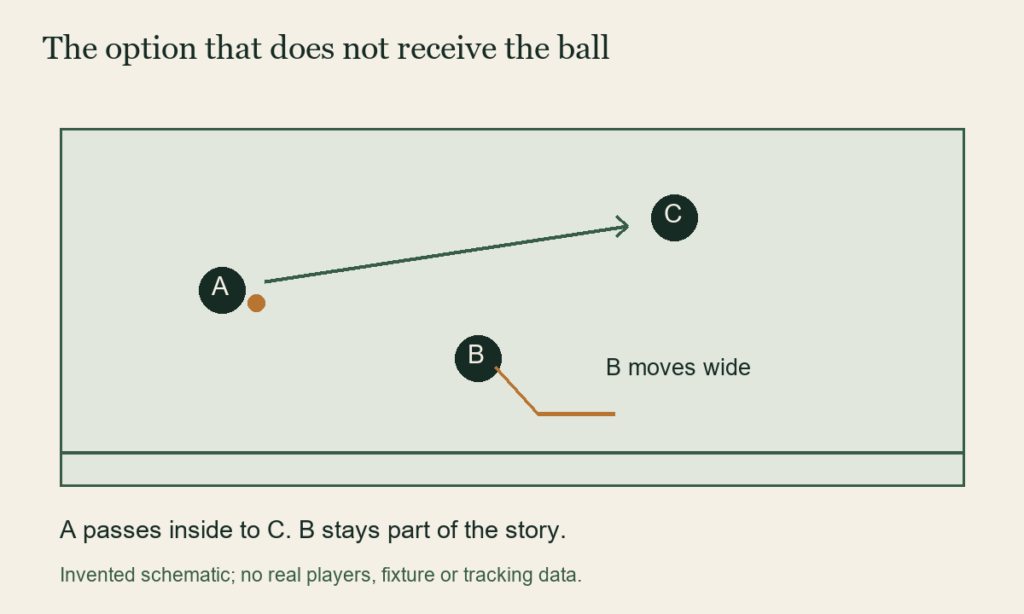
The ball gives a football match its most obvious storyline. A second story happens around it: a run that makes an option available, a defender who holds position, a teammate who moves and never receives the pass. You can give that movement proper attention without pretending to know a manager’s instructions.
This is a watching exercise, not a report of a match we attended. Its worked passage is invented. The aim is a modest one: finish with a clear description, a possible explanation and an honest account of what your view did not reveal.
What should you follow for one passage?
Choose one player away from the ball. Stay with them through a short passage rather than trying to follow the whole team. Note where they begin, what changes around them and where they finish. If you lose sight of them, record the gap. Filling it with a likely movement would turn your note into a reconstruction.
Use a fixed landmark such as the touchline to describe direction. “Moved towards the near touchline” remains understandable when a sketch is turned around. “Moved right” needs an explanation of whose right you mean. An approximate distance is enough if you cannot measure it; do not add a precise number just because a diagram has neat lines.
What does the invented example actually show?
Imagine a short passage with three teammates: A has the ball, B begins between A and the near touchline, and C waits farther inside. D is a nearby defender. The sketch shows their positions schematically; it is not to scale and does not come from tracking data or a real fixture.
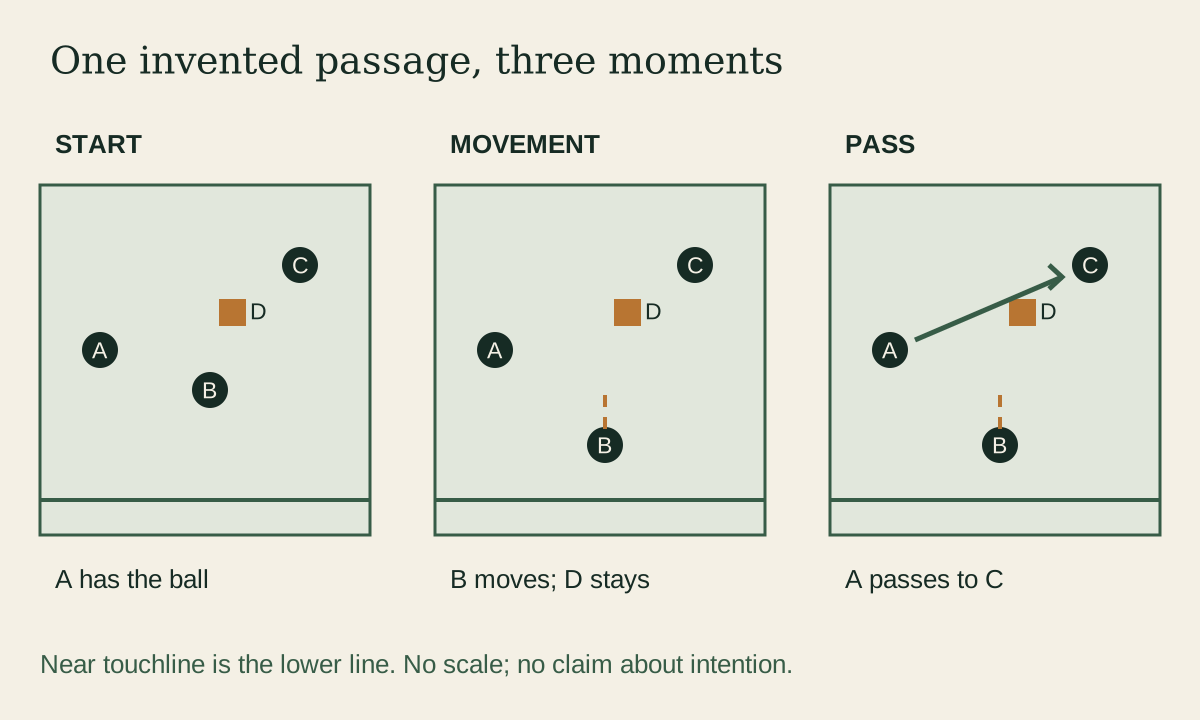
| Moment | Visible in the model | Still unknown |
|---|---|---|
| Start | A has the ball. B is nearer the touchline; C is inside. | What options A can see from pitch level. |
| Movement | B moves nearer the touchline. D stays in place in this sketch. | Whether D is watching B or following another instruction. |
| Pass | A passes to C. B does not receive the ball. | Whether B’s movement influenced A’s decision. |
The description supports “B moved wide before the inside pass”. It does not establish “B was ordered to create the pass” or “D ignored the run”. Those sentences introduce instructions, attention and causation that the model does not supply. B may have offered a useful option; the pass going elsewhere does not prove that the movement was pointless.
How do you keep an explanation separate?
Give your note three short lines. First, write the visible sequence in ordinary language. Second, add a possible interpretation with a word such as “may”. Third, name one observation that would help distinguish it from another explanation. The third line is what stops a plausible story hardening into a claim.
Observed: B moved towards the near touchline before A passed inside to C.
Possible reading: B may have been offering a wide option.
Open question: Was the wide passing lane open from A’s position?
A rival reading could be that B was simply returning to a preferred position after an earlier phase. Our short invented passage cannot decide. You do not need to choose a winner to make the note useful. Keeping both possibilities visible tells a later reader what further context is missing.
What changes when your view is incomplete?
From a stand or touchline, another player can hide the passing lane. The near player may look farther from the ball than they are. A recording may cut away just before the movement you want to follow. Treat these as limits on the observation, not invitations to fill the frame with confidence.
Where a recording is lawfully available, a second viewing can help. First repeat the same observation, then look at the ball carrier. Keep the two notes separate until you compare them. A replay can clarify a position while still leaving a player’s intention unknown. Do not reproduce footage or identify spectators merely to decorate a note.
When is a repeated movement worth recording?
Look for a similar situation, not just a similar run. Was possession settled or changing? Was the player starting from the same area? Could the ball carrier see the same options? A movement repeated under different conditions may answer a different problem.
For a second passage, reuse the three lines: observed, possible reading, open question. Add one sentence on what changed between passages. Avoid turning two examples into a frequency claim about a whole match. If you want to say “often”, you need a defined stretch of play and a record of the other occasions too.
End with one contribution you can describe and one uncertainty you kept. That is enough for a useful watching note. If it becomes part of a match account, the sequence behind the scoreline should be checked separately. A careful account can notice work away from the ball while leaving the dressing-room conversation to the people who were actually there.